Good evening,
I want to begin by saying how pleased I am that much has happened since our County Board meeting in December.
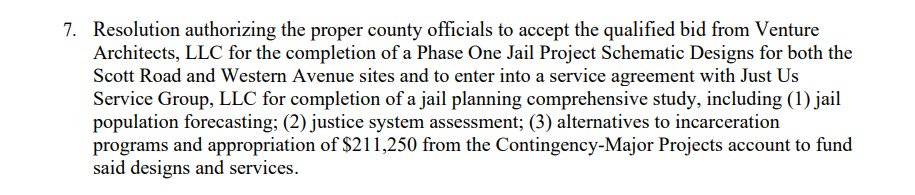
It has now been recognized that we need a new consultant, Tom Weber, to review the 450-bed projection for our jail. I did not expect that shift after the discussion at our last meeting, but I believe it is extremely important. I am very impressed with Mr. Weber’s credentials.
I think Supervisor Luehring’s suggestion at last February’s meeting that we needed more consultant eyes on this project was on point. I apologize to her here tonight for not speaking up at the time when she was misunderstood and publicly criticized for raising that concern.
Based on Mr. Weber’s recent presentation, it was also decided that we need a comprehensive review of our justice system: How are we functioning? Who is placing individuals in our jail? Can we reduce the jail population or length of stay? Should we establish a Criminal Justice Coordinating Council, as most other Wisconsin counties have done?
This decision came just eight days ago following a consultant presentation. Yet the idea of taking a broader systems approach has been raised since the beginning of the Ad Hoc Committee in July 2024. Why did it take so long? I have said before that this process is deeply flawed. Still, I am very glad this work is now underway.
Let me speak about the process.
When the Ad Hoc Committee began in 2024, my understanding was limited. I had voted to purchase the land on Scott Road based on the information provided in the resolution at that time. I have since reviewed the meeting video. There were no questions or discussion of why we needed to do that or how we would go forward.
I vaguely remember talking with County Ex Al Buechel and you can imagine that I asked about cost. I remember the number of $60M. At that time, that was a lot of money, but not of the scale of what we are talking about now. I do not believe any of us anticipated how dramatically the scope and cost might change.
When the Ad Hoc Committee was formed, I believed we would move forward deliberately and transparently. By then, I was was aware that Wood County had experienced major cost escalation on its jail project. I asked if the Ad Hoc meetings could be recorded. They were not. It is hard when you are working to attend meeting held at 1pm in the afternoon. It was summer, lots of us travel, have family commitments and it isn’t easy to attend meetings.
I have spoken with citizens who did attended those meetings. One comment I repeatedly hear is: “Is the fix in?” Some believe the consultant had already decided on an outcome and was simply persuading the committee. I do not share that belief, and I push back on it whenever I hear it. However, perception matters. In the past week alone, I have heard multiple people say, “This is a done deal.” That resignation troubles me.
People already have low trust in elected officials. I do not want that to apply to this Board. I have deep respect for my fellow Supervisors. We volunteer our time to serve our community and make difficult decisions for the greater good. That work deserves public confidence.
Which brings me to the issue of misinformation.
I have heard that word used frequently regarding the Jail/Justice Center project. But it is the County’s responsibility to provide clear, accessible information. It is not realistic to expect citizens to attend every meeting or independently track down documents.
Local media coverage has declined significantly. Fewer reporters attend government meetings. Letters to the editor and opinion columns have diminished. Meanwhile, the County now records meetings and posts documents online. So there has been a shift.
It is inefficient to expect individual Board members and staff to answer the same questions repeatedly through separate emails and phone calls. The County must provide centralized, proactive communication.
The public must be a partner in this process from the beginning. Community awareness surged in December 2025. We now have the public’s attention. The next step is earning their trust, and that requires transparency and engagement.
At the Ad Hoc Committee’s second meeting, members discussed communication and decided that only the chair would speak publicly about the project. A citizen present at that meeting told me this week that this was the moment they began to feel the process was happening outside public view. They believed the consultant recommended limiting communication. When community members later requested a presentation to a local group in December 2024, they were told it was not the right time.
I am relaying what I was told to illustrate how perceptions form. Whether or not those perceptions are accurate, they are real to the public.
Even now, the process remains unclear—both to the public and to me as a County Board member. What are the defined steps? What decisions are made when? Where does the full Board weigh in?
Other counties, such as Portage and Green, have clearly outlined process diagrams showing each phase and decision point. Our path has felt fragmented. Even after attending the recent Executive Committee meeting, I left wondering: What is next? How will major decisions be compressed into such a short time frame?
We are told it is our responsibility as Supervisors to inform our constituents. I have spent countless hours doing exactly that, as I know others have as well. It has been rewarding to engage with citizens who ask thoughtful questions and offer helpful suggestions. But is this the most efficient way to operate?
Meetings may be technically open, and minutes may be posted, but accessibility remains an issue. Do you know how hard it is to hear in Room H? It doesn’t work. Are we going to permanently fix that? County Board meeting recordings have been missing from the website since last October. The jail project webpage exists, but it is difficult to find and updates are not always timely.
For example, Sheriff Waldschmidt gave an important presentation at Public Safety. It took days for that information to appear online. Meanwhile, we spent much of last year without addressing key questions, and now we are compressing major decisions into a matter of weeks.
This is the email I got last night from Sheriff Waldschmidt:
“I’m working as hard as I possibly can doing my best to keep up with all the questions coming in, and get everyone the answers they are seeking (while still dealing with everything else that comes with being sheriff that is not related to the jail project!). It has not been a good start to the week. Fatal house fire yesterday, a horrible fatal crash with multiple others injured this afternoon. It’s been quite a tragic stretch here the last few days. Please know I’m working as quickly as I can to respond to the jail questions for everyone.”
Sheriff Waldschmidt, You are an incredible person. It is always great to talk with you. You keep our community safe and for years you have been working on improving the jail facility and operation. You carry a very large burden for our County and I am eternally grateful for all that you and your dedicated staff do for our County.
Relying on individual departments to respond piecemeal to growing public concern is not sustainable. Our process must support them better.
Supervisor Luehring suggested holding Committee of the Whole meetings so all Supervisors—and the public—could hear the same information simultaneously. That approach would promote transparency and efficiency. When we had a Board quorum at the recent Executive Committee meeting, there was no reason it could not have been structured that way.
Cost is another major concern. We do have cost estimates. This will likely be the largest capital project in County history. Our taxpayers already pay higher property tax rates than neighboring counties. Whatever decision we make, we must bring the public with us—especially on cost.
This project is complex. It began as a jail overcrowding issue. The courts were later incorporated, and only recently did I fully understand the urgency of court security deficiencies. The lack of separation between public, staff, and inmates zones creates real safety risks. I believe court security may need to be addressed more urgently and perhaps separately, particularly since the phasing plan does not relocate courts immediately even if a new jail is built.
We must also consider the possibility that long-term demand could change. Our child population is declining—a historic shift in Wisconsin. State wide juvenile detention numbers are decreasing significantly. I want to thank County Board candidate, Jim Sippel for pointing that out to me. Alcohol and drug use drive much of our crime, including homicides linked to fentanyl. Diversions, more and better treatment. Winnebago County diverts 20% of their jail admissions, could we do that?
These are serious questions.
Citizens are also asking about maintenance of the current facility. How will we keep it operational during what could be a three-year design and construction process? I see limited reference to this in the Capital Improvement Plan. There are also questions about when we will be bonding for design costs, which could reach into the millions. None of this is in the CIP.
Public listening sessions are planned after schematic designs are completed. Many citizens feel that is too late. They want to participate now—before major design decisions are locked in. They want options on the table and meaningful discussion about site placement and alternatives.
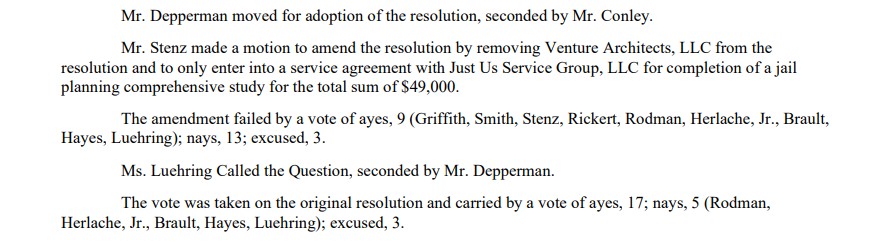
Because of these unanswered questions, the compressed timeline, and the lack of a clearly defined, transparent process, I cannot support this resolution at this time.
For those reasons, I will be voting no.
If We Can’t Staff This Jail, Why Build a Bigger One?
Before we build a bigger jail, we need to answer a simpler question: why can’t we properly staff the one we already have?
I recently reviewed five years of Department of Corrections inspection reports for our county jail. In 2021 and 2022, when the jail population was under 200, there were no statutory violations. As the population climbed toward 300 in the following years, violations began to appear—and they have continued every year since.
One violation stands out. State rules require jail staff to personally check on inmates at least once every 60 minutes. The reports show that these checks are not consistently happening during the day. This isn’t a mystery or a paperwork error. Sheriff Waldschmidt has explained that as the jail population grows, more inmates must be transported to court. Staff are pulled from the jail to handle those transfers, leaving fewer officers inside the facility to meet basic safety requirements.
Jail Supervisors now spend nearly half their time helping with transports. Only two full-time officers are assigned to that job, even though the Sheriff estimates five are needed. Requests for additional staff have been denied. The result is predictable: safety violations and staff not doing their regular duties.
Medical care is another warning sign. While a 2023 violation related to delayed health assessments was corrected, the state has repeatedly noted that jails of similar size have moved to 24/7 medical coverage. Ours has not. Medical services are provided only 16 hours a day. At night, inmates are transported to emergency rooms, and correctional officers—who are not nurses—dispense medications.
Both the state regulator and our Sheriff are telling us the same thing: the current facility is not being adequately staffed or resourced. Yet we are being asked to believe that if we build a larger jail, the staffing and medical funding will somehow appear.
At a recent listening session, a citizen asked the most important question of all: If we can’t afford to staff the jail we have, how will we afford to staff a bigger one?
That question deserves an answer—before we spend millions expanding a system that is already stretched thin. Fixing staffing, safety, and medical care in the existing jail should not be optional. It should be the first step.